
The applicability of fiber lasers (usually with a wavelength of 1064nm) for stone engraving depends on the mineral composition, color, density and laser power of the stone. The following is an analysis of the comprehensive search results:
Types of stones suitable for fiber laser engraving
Dark granite
Black or dark granite (such as Shandong Zhangqiu black and Indian black granite) has the best engraving effect due to its high absorption rate, and can present clear light-colored text or patterns.
White granite has a poor effect and is difficult to display due to its high reflectivity.
Marble
Dark marble (such as black gold flower and dark green) can be engraved, but the power needs to be controlled to avoid surface burning and blurring.
Light-colored marble has a weaker effect and needs to be enhanced by subsequent dyeing (such as gold/silver paint filling).
Slate and sandstone
Slate: soft texture, uniform texture, suitable for engraving wall decorations or landmarks.
Sandstone: loose and porous, the laser easily vaporizes the surface, suitable for engraving rough textures.
Tuff and river stone
Tuff: The porous structure is conducive to laser ablation, suitable for relief or architectural decoration.
River stone: Smooth black river stone (such as pebbles) can be engraved with corporate logos or commemorative texts, but it needs to be fixed to prevent rolling.

Stones with limited effects or high power requirements
Light-colored quartz stones
Due to high reflectivity, ordinary fiber lasers (<100W) are difficult to display, and kilowatt-level power is required to vaporize the surface.
Jade (such as Hetian jade and jadeite)
Jade is a silicate mineral aggregate with a hard and light-transmitting texture, which is difficult to be effectively ablated by fiber lasers. This type of stone is more suitable for CO2 laser (wavelength 10.6μm) engraving.
High-hardness igneous rocks
Basalt, gabbro, etc. require extremely high power (>3kW) to penetrate, and have low efficiency, and are rarely used in industry.
Key influencing factors
Color and light absorption
Dark stones (containing iron and manganese minerals) have high light absorption and good engraving contrast; light-colored stones need to be dyed or high-powered.
Power requirements
Fine engraving: 50W–200W fiber lasers can process dark granite and slate.
Deep cutting/drilling: kilowatt-level power is required (such as 3.2kW to penetrate 300mm sandstone).
Surface treatment
After engraving, polishing or dyeing (coating with gold/silver pigments) is often required to enhance the visual effect.
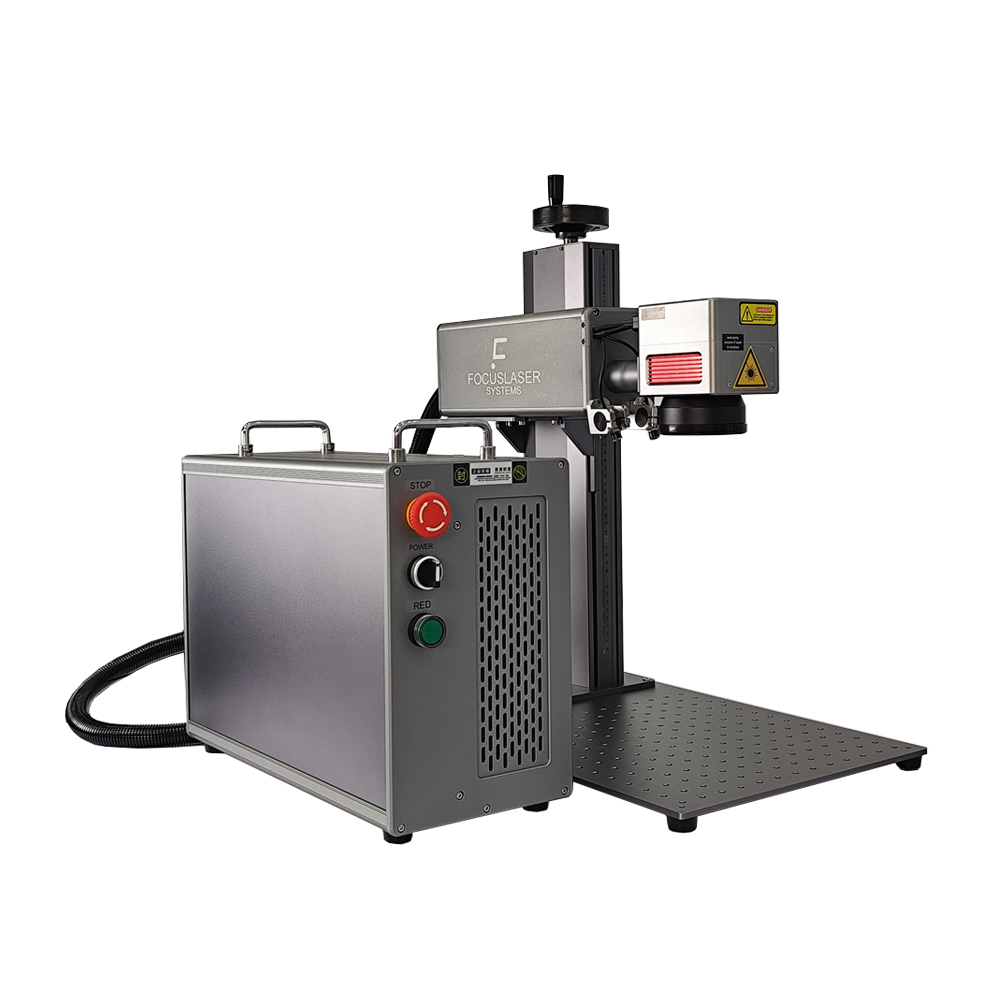
Typical application scenarios
Industrial field: tunnel drilling, oil and gas well drilling (high-power fiber laser).
Craft gifts: granite medals, marble nameplates, river stone souvenirs.
Architectural decoration: slate murals, sandstone reliefs.
Fake warning: Unscrupulous merchants use lasers to forge “tumor scars” on stones such as thuja, so be wary of artificial traces.
Summary and suggestions
Stone type Applicability Required power Effect characteristics
Dark granite ★★★★☆ 50W–200W High contrast, clear edges
Marble (dark) ★★★☆☆ 100W–300W Need to prevent overburning, can be dyed for enhancement
Slate, sandstone ★★★★☆ 50W–150W Natural texture, suitable for rough processing
River stone, tuff ★★★☆☆ 100W–200W Porous structure is easy to carve
Jade, light-colored quartzite ★☆☆☆☆ Not recommended Low efficiency, it is recommended to use CO₂ laser instead
Conclusion
Tip: For jade, semi-precious stones or light-colored stones, CO₂ laser (wavelength 10.6μm) is a better choice because it has a higher absorption rate for non-metals8. Fiber laser is better at metal engraving, and the stone field needs to “select the right material for the right condition” to play its advantages.
