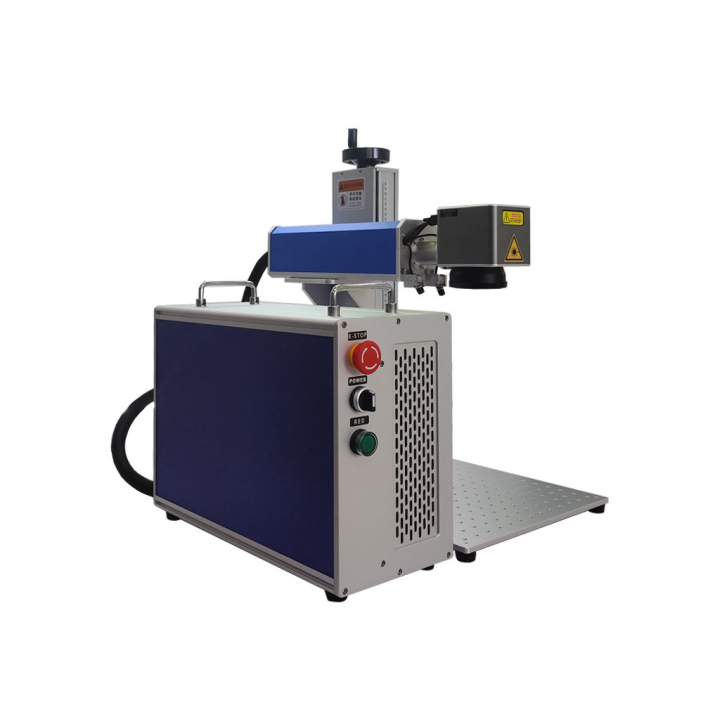
Choosing between a fiber laser and a UV laser marking system for plastic access cards is a common dilemma. While both are effective, their results are vastly different, and so are their costs. This article provides an in-depth comparison to help you make the most informed decision.
Core Principle: Thermal Processing vs. Cold Processing
Fiber Lasers (typically 1064nm infrared wavelength) utilize a thermal processing mechanism. The heat generated by the laser beam carbonizes, melts, or evaporates the material surface, forming a mark through chemical reactions and color change.
UV Lasers (355nm ultraviolet wavelength) employ a cold processing mechanism. High-energy ultraviolet photons directly break the chemical bonds of the material, causing precise ablation of the surface layer through photochemical reaction with minimal heat generation.
This fundamental difference dictates all the variations in their final results.
Side-by-Side Comparison Chart
| Feature | Fiber Laser Marking Machine | UV Laser Marking Machine | Winner |
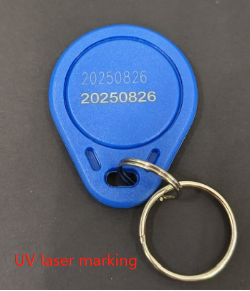
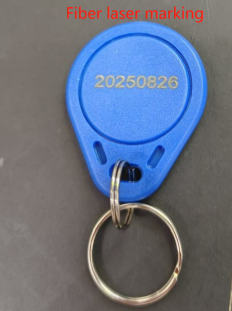
| Mark Color | Typically dark (black, brown), achieved via carbonization. Contrast is very low or ineffective on light-colored plastics. | Extremely flexible. Can produce pure white, light yellow, and other high-contrast light-colored marks on light plastics. Excellent on dark plastics too. | UV Laser |
| Precision | Moderate. Thermal effect causes slight edge melting, making it difficult to engrave very fine lines (<0.2mm). | Super high precision. No thermal diffusion allows for extremely fine lines (up to 0.02mm), micron-level text, and ultra-high-density QR codes. | UV Laser |
| Contrast | Low to Medium, highly dependent on absorber content (e.g., carbon black) in the plastic. | Extremely High. Produces top-tier contrast marks on substrates of any color. | UV Laser |
| Material Compatibility | Selective. Works well on dark plastics with absorbers (e.g., black ABS). Poor results on most light/pure-color plastics. | Nearly Universal. Suitable for all engineering plastics (ABS, PC, PET, PVC, etc.), regardless of color. | UV Laser |
| Material Damage | Significant. Thermal effects alter the surface structure, potentially causing etching, melted edges, and stress, which may warp thin cards. | Minimal. The “cold processing” nature creates No Heat-Affected Zone (HAZ), leaves the subsurface untouched, results in a smooth surface, and preserves mechanical properties. | UV Laser |
| Marking Speed | Generally Faster. | Generally slightly slower than fiber, though modern high-end UV systems are very fast. | Fiber Laser |
| Equipment Cost | Lower. Mature technology, cost-effective. | Higher. Typically several times the cost of a fiber laser system. | Fiber Laser |
How to Choose? Practical Advice for You
Choose a Fiber Laser Marking Machine if:
Your access cards are predominantly dark-colored (e.g., black, dark blue).
Your marks are primarily internal serial numbers, dates, or simple barcodes where aesthetics are not critical.
Your budget is limited, and upfront equipment cost is a priority.
Choose a UV Laser Marking Machine if:
Your access card range includes a significant number of white, yellow, or other light-colored cards.
You need to mark high-definition logos, very small text, micro anti-counterfeiting QR codes, or any pattern where superior aesthetics are required.
You demand top-tier mark quality, contrast, and permanence on cards of all colors.
Your budget allows for it, and you believe exceptional marking quality is a worthwhile investment.
Conclusion
In summary, this is a showdown between “Cost-Effectiveness” and “Top-Tier Performance”.
A Fiber Laser is like an efficient soldering iron—it provides reliable “branding” on dark materials at a lower cost, perfect for functional marks.
A UV Laser is like a precision engraving pen—it “creates” with unparalleled fineness and clarity on cards of any color, ideal for branding and security marks.
For most access card manufacturers, if your product line is diverse in color and prioritizes aesthetic quality, the UV laser is undoubtedly the superior, more versatile professional choice. If you only handle dark cards and require simple markings, the fiber laser is a reliable and economical solution.